What's On
We offer a range of public activities throughout the year. Our temporary exhibitions include displays of current research, work by artists, and our community cabinet displays co-curated by visitors, students and community groups.
Events and Activities
Summer School of Rock: Drop In and Rock Out

Wednesdays in the summer holidays, 10am - 1pm, free, drop-in
Join us this summer for mountains of geological fun! Drop in to meet scientists and Sedgwick Museum staff from the University of Cambridge Department of Earth Sciences, and take part in fun, hands-on activities relating to their work. Handle real fossils and amazing rocks, 'meet' the famous 19th century palaeontologist Mary Anning, and delve into the science of meteorites, volcanoes, microscopic fossils and more.
Drop-in events will run every Wednesday, 10am - 1pm, in the summer holidays. See below for more details:
22nd July
Drop in and meet Dr Rayssa Martins-Pimentel, a cosmochemist who studies the chemistry of meteorites to find out what planets are made of. Handle real meteorites, have fun spotting the difference between space rocks and Earth rocks, and chat with Rayssa about her work.
29th July
Meet volcanologist Julian Pahl, who studies lava rocks from Hawaii to investigate volcanic eruptions, and take part in fun, hands-on activities relating to his research. Explore beautiful lava minerals under powerful microscopes, handle real (cooled!) lava, and use syrup and fizzy drinks to learn how lava flows. Chat with Julian about his expeditions to Hawaii and find out what it's like to investigate volcanoes as a job.
5th August
Explore real rock and fossil specimens from the Sedgwick Museum collection. Discover fossils of animals so ancient that they went extinct before dinosaurs even evolved, and investigate rocks that glow under UV light. Chat with Museum staff about their favourite fossils and find out what it's like to work at the Sedgwick Museum.
12th August
Drop into the Sedgwick Museum to celebrate the ground-breaking 19th century palaeontologist, Mary Anning. Hear about her revolutionary fossil discoveries by ‘meeting’ Mary in person, and find out about her experience as a working-class woman scientist in the 1800s. Investigate Mary's fossil finds with her, and find out how some of her most spectacular discoveries came to be in our Museum collection. Step back in time and have fun dressing up as Mary and her brother Joseph.
19th August
Drop in to meet Earth scientists Jeannie Booth, Mengyao Du and Simon Crowhurst and explore amazing, tiny 5000-year-old fossils under powerful microscopes. Discover what these microfossils can tell us about oceans and climates thousands of years ago. Compare the features of different microfossils and get stuck into making your own microfossil model out of clay, to take home.
26th August
Have you found a rock or fossil that you’d like identified? Perhaps found over the summer holidays? Drop in with your finds and our Museum scientists can help you identify them. You can also learn how to find fossils in everyday gravel, and get hands-on with some of our amazing fossils and rocks.
Bridging Binaries: LGBTQ+ Tour

The tour on Friday 14th August has been cancelled due to high temperatures in the Museum this week. We apologise for any inconvenience caused.
Friday: 28th August, 1pm - 1.45pm
Wednesdays: 9th and 23rd September, 1pm - 1.45pm
Free, drop-in (booking required for groups)
We are proud to present our LGBTQ+ tour as part of the University Cambridge Museums' Bridging Binaries programme.
It is hard to say for certain that a 19th century scientist was queer just from their memoirs. It is difficult to know whether they were in a romantic relationship with the 'secretary' they lived with, or were they just that - a secretary. In the same era, were the two women who lived together for thirty years really just 'close friends'? Looking for queerness in Museum collections can be challenging.
Join us to explore and celebrate queer histories linked to our collections and people, extricated and inferred from letters, choice words and omissions.
For age 18+.
FREE, drop into our shop to book your free place on the tour. For group bookings, email the Museum: sedgwickmuseum@esc.cam.ac.uk
Illustrations by Layo Danbury, 2025
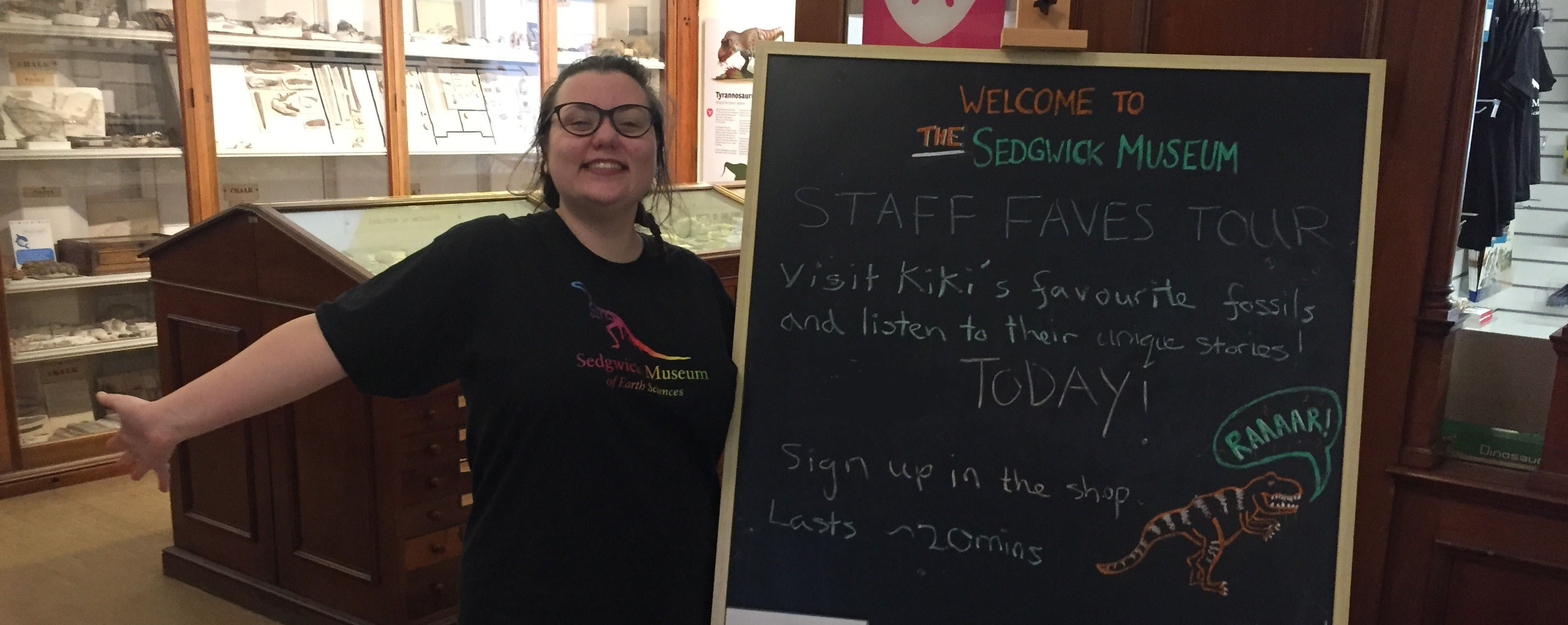
Staff Favourites Tours

Friday 7th and 21st August July, 1pm - 1.30pm
Wednesdays 2nd, 16th and 30th September, 1pm - 1.30pm
Free, drop-in
Come and be inspired by the displays and objects that our staff love.
Giant deer, fossil fish teeth, the rocks that built Cambridge... just some of the specimens on display that our staff can't wait to discuss with you. Beware, their enthusiasm is infectious!
Drop into our shop to book your free place on the tour.
We also have regular fossil handling activities on Saturdays and in school holidays, please do phone (01223 333456) to check what's on when you plan to visit.
Exhibitions
From Magma to Magnets

Free, drop-in
Discover the work of Earth scientists studying ancient magma chambers in Greenland, in this new display.
How do rare earth element-rich minerals form? What makes some minerals 'critical' and not others? Why are they in the news so often? Discover the work of a small team of Earth Scientists at the University of Cambridge, who study minerals that formed in magma chambers millions of years ago in Greenland. The minerals contain ‘rare earth elements’, which due to their use in powerful magnets are crucial to high-tech industries and the global transition to green energy.
Feel the powerful force of a rare earth magnet yourself, make critical minerals glow and sparkle under UV light, and delve into the awe-inspiring process of how the minerals formed.
Breaking New Ground: Celebrating Past, Present and Future Women Earth Scientists at the University of Cambridge

Join us in celebrating women Earth scientists in this temporary display, co-curated by two Earth Sciences students.
Free, drop-in
How many women Earth scientists can you name? With a focus on the University of Cambridge, Breaking New Ground is a celebration of women in Earth Sciences.
The display includes trailblazing, but historically overlooked early Earth scientists, perspectives from women who are currently researching, teaching, working or studying in the university's Department of Earth Sciences, and two local young people who share their passion for Geology.
This exhibition was co-curated by two Earth Sciences students at the university.